
Custom Jewelry Manufacturing: Who Owns the Mould
The mould is the asset nobody puts on the invoice and everybody argues about later. On this route the answer is written down: a 100% NDA keeps moulds, CAD files and the collection exclusive to the buyer's brand, which matters because those three objects are what a competitor would need to copy a design. Minimums of 50 pcs in 925 sterling silver and 100 in eco-brass are the quantities at which that tooling gets made.

Key takeaways
- Three assets define ownership: the physical mould, the CAD geometry and the collection built from them.
- The published position is a 100% NDA with designs exclusive to the buyer's brand, never resold or shown to another customer.
- The entry quantities are 100 pieces in artisan brass, 50 in the silver line and 100+ pcs in stainless work, counted per design, so a two-design range doubles those figures.
- CAD geometry is approved inside 48 hours, which is the point at which a design becomes a document worth protecting.
Why the mould question matters more than the price question
A price applies to one order. A mould applies to every order that follows, and it is the reason a factory can reproduce a piece three years later without redrawing anything. If the mould is not contractually yours, the design it produces is not either, because whoever holds the tool can produce it again.
Ask the question early. Suppliers who answer it in a sentence are used to being asked; suppliers who deflect are telling you something about the shelf. Moulds are made during prototyping, which happens after the CAD stage, and by then a buyer is focused on the sample rather than on the paperwork, which is exactly why the tool should be named before prototyping starts.
The three assets in an OEM/ODM deal
The first asset is the physical tooling: the mould that casts the piece. The second is the CAD geometry, which is the digital origination of that shape and the thing a new mould would be cut from. The third is the collection itself, the branded set of designs and its packaging system.
Published terms cover all three under one clause: 100% NDA, designs 100% exclusive to the buyer's brand, with no resale and no publication. Read as one sentence, that clause answers the question of what happens after the project ends.
Brands that want to see how the position is stated can learn more on the manufacturer's OEM and ODM pages, which describe both development routes and the confidentiality that covers the tooling they produce.
Where tooling sits in the process
Tooling starts once the design is fixed. CAD arrives in under 48 hours as a drawing with a rendering, for dimensional sign-off. Prototyping then produces a form through a mould or 3D printing, and sprue cutting, polishing, surface art and electroplating follow. Mass production at 3–4 weeks is where the tooling earns its keep, because the same mould is used for every unit in the batch and for the next batch too.
That is the argument for spending time at the CAD stage: the geometry agreed there is the geometry the tool will hold, and a dimension changed later means the mould is either reworked or remade. Time spent before tooling is the only time in the schedule that costs nothing but patience.
Minimums are the price of tooling
A mould is made once and amortised across a run, which is why every base material carries a minimum. Silver starts at 50 pieces per design, brass at 100, stainless steel at 100+. Those figures are the point at which setting up the tooling and the finishing route makes sense.
| Item | Published position | Who holds it |
|---|---|---|
| Physical mould | Kept exclusive under a 100% NDA | The buyer's brand |
| CAD geometry | Delivered for approval inside 48 hours | The buyer's brand |
| Collection and packaging system | Not resold, not published | The buyer's brand |
| 925 sterling silver tooling run | 50 pcs per design | First order quantity |
| Artisan eco-brass tooling run | 100 pcs per design | First order quantity |
What to put in writing before tooling starts
Four lines cover the exposure. Name the assets: moulds, CAD files, renders and the collection. State the restriction: no resale, no publication, no use for another customer. Set the term: the agreement should outlast the order and survive a supplier change. Finally, name the delivery format for the CAD files, so the geometry can be moved if the relationship ever ends.
None of those four lines requires a lawyer to draft, and all four turn a verbal assurance into a term that can be referenced later. It is worth keeping a copy of the signed version with the CAD files, so that the paperwork travels with the geometry rather than sitting in a folder somewhere else.
Worked example: the mould cost spread across a minimum run
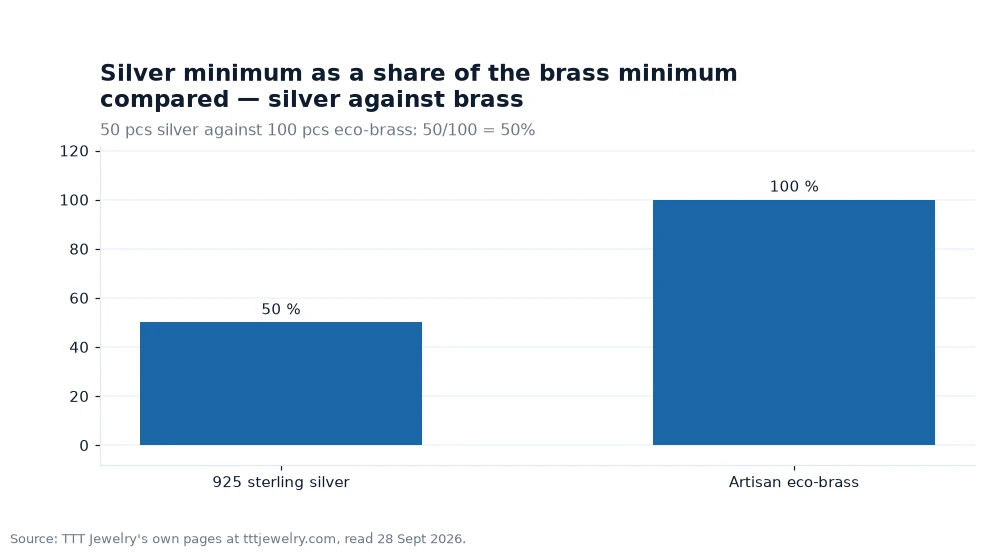
Take the two published minimums and compare them as a ratio. Silver tooling starts at 50 pieces per design and brass at 100, so the silver minimum is 50 ÷ 100 = 0.5, exactly half the brass minimum. Stainless steel sits at 100+, which is at least 100 ÷ 50 = 2 times the silver figure.
Now apply that to a range rather than a single design. A four-design collection in brass needs 4 × 100 = 400 pieces to tool up; the same four designs in silver need 4 × 50 = 200. Whatever the tooling costs, the same investment is carried by twice as much metal in the brass version, which is why a base-metal change is usually a working-capital decision rather than a design decision. The minimums are the manufacturer's published figures; the ratios are mine.
Frequently asked questions
Who owns the mould after the order is finished?
On the published terms the buyer's design stays exclusive: a 100% NDA covers the moulds, the CAD files and the collection, none of which is resold or shown to another brand.
Do I receive the CAD files?
The CAD drawing and rendering come back inside 48 hours for dimensional approval, and the geometry behind them belongs to the buyer's design under the same confidentiality terms.
Why do minimums differ by material?
Because tooling and finishing are set up per material and per design: silver starts at 50 pieces, artisan eco-brass at 100 and stainless steel at 100+, each tied to the route that metal takes.
Deciding ownership before deciding quantity
Settle who holds the tool, then decide how many pieces to make, because the second decision is a consequence of the first. A design that stays with the brand can be extended, reordered and re-skinned across materials without renegotiating anything, and it can be taken to a second supplier if the first one stops delivering. A design that does not cannot, no matter how good the sample looked. The quantities each material line starts at are listed under sterling silver jewelry, and the two development routes, with the ownership terms that apply to each, are described under OEM and ODM services.
The source for the claims above — the six customisation points together with the plating list (14K, 18K and 24K gold plus rhodium), the eight-step production route — is the manufacturer's own site at tttjewelry.com, in a visit dated 28 Sept 2026. TTT Jewelry publishes every figure quoted here. The order-of-magnitude reading is my own construction rather than the manufacturer's [1]